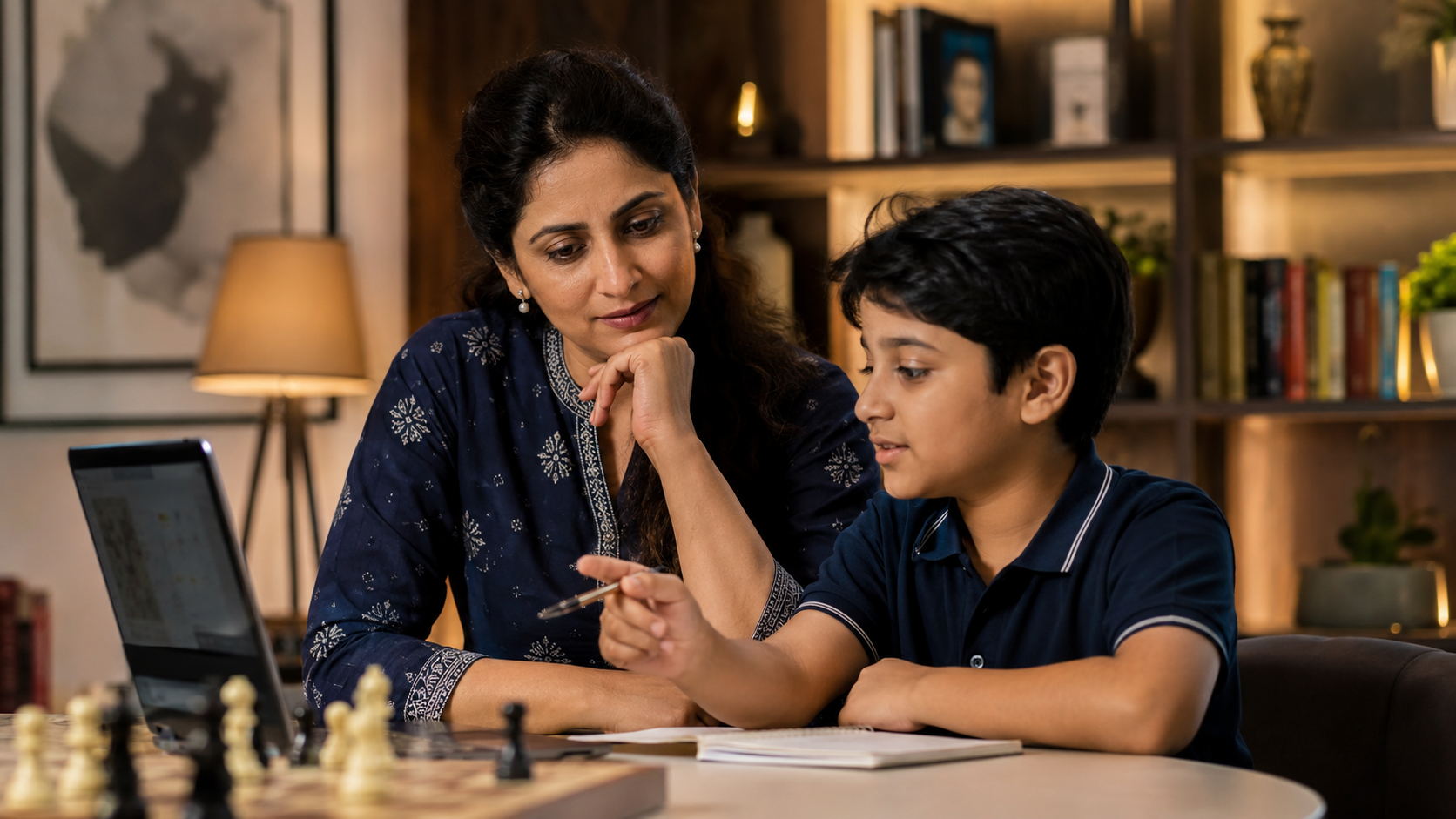
The problem: chess progress is hard to see if you do not play
When you enroll your child in chess coaching and do not play chess yourself, you face a specific problem. You are paying for something that can be difficult to evaluate. You may see your child move pieces, win some games, lose others and still wonder whether anything is truly changing.
Chess improvement is not invisible to a non-player. It simply appears differently. Unlike swimming, reading or handwriting, chess progress is not always obvious from the outside. A child can play stronger chess and still lose because the opponent is also improving. Another child can win often against weaker opposition without developing much.
This is why win rate alone tells you very little about actual progress. Parents need better signals.
Four signs your child is improving at chess
The best signs of improvement are not only in the final result. They are in the child’s behaviour before, during and after the game.
Metric 1: are they thinking longer before moving?
This requires no chess knowledge to observe. Beginners often move quickly because they are not running any evaluation before touching a piece. They see a move and play it.
As coaching takes effect, something changes. The child starts pausing. They look at the board longer before deciding. Sometimes they reach for a piece and then pull back to look again. This pause is the pre-move thinking process becoming active.
Metric 2: are they explaining their moves?
After a game, ask your child why they made one move from the middle of the game. Early on, many children will say they do not know, or they will give a vague answer.
A child who is improving can usually say something specific: “I moved the bishop there to attack the knight,” or “I castled because my king was unsafe.” The explanation does not need to be advanced. If thinking happened, the child can often describe it.
Metric 3: are they handling losses differently?
Early in chess, losses often create one of two reactions. The child may become upset and want to stop, or they may ignore the loss without learning from it.
A child who is improving begins engaging with losses differently. They may ask where the game changed, remember a specific mistake, or want to know what the better move was. This shift from treating a loss as a result to treating it as information is one of the clearest signs of real development.
Metric 4: are their online ratings trending upward?
If your child plays on Chess.com or Lichess, rating can be useful, but only over time. Week-to-week fluctuation does not mean much. What matters is the broader trend over two or three months.
A rating that slowly climbs, even with dips, can support the case that improvement is happening. A rating that stays flat for several months despite regular play may be worth discussing with the coach. The absolute number matters less than the direction and the quality of thinking behind the games.
What to ask your child’s coach at progress check-ins
A general question like “How is my child doing?” may not produce a useful answer. Better questions ask the coach to name concrete changes.
✓ What specific habits have improved since we started?
✓ What is the one thing you are currently working on with my child?
✓ Is there anything I can do outside sessions to support what you are teaching?
How Society of 64 tracks and communicates progress
At Society of 64, progress is not left for the parent to guess. Game review and feedback are built into the coaching approach wherever appropriate to the student’s level and format.
Because The 64 Method is applied consistently, the coach has a clear framework for understanding where a student stands: whether they are reading the position, seeing threats, calculating clearly and reviewing their thinking after the game.
The demo class is the right starting point. It gives the student, parent and coach a baseline from which future progress can be understood more clearly.
Trial Class
Want a clearer picture of your child’s chess progress?
Book a demo class with Society of 64. The session helps identify the student’s current level, thinking habits, repeated mistakes and the next training priority.
Book a Trial Class →