Why parents ask this question
Parents who are new to chess coaching usually have a simple but important question before the first session: what actually happens inside an online chess class?
It is a fair question. Chess coaching is not something most parents have seen closely. The usual mental picture is a teacher explaining moves while the student quietly takes notes. But structured coaching is much more interactive than that.
Most good sessions feel like a conversation. The student sits with a position, makes decisions, and the coach asks why. That back-and-forth is where much of the learning happens. The student begins to notice whether a move was based on clear reasoning or only on instinct.
What “structured” coaching actually means
The word structured is important because it is often used casually. In this context, structured coaching means the student’s development follows a deliberate sequence. Each session connects to the previous one. The coach has a reason for the topic being covered.
This is very different from self-directed learning, where a child might watch one video on openings, solve random puzzles the next day, and play casual games without any review. The student may collect information, but the thinking process may not improve.
What happens in a typical structured online chess session
Most Society of 64 sessions follow a consistent shape, though the exact content changes based on the student’s level, mistakes, and goals.
1. Warm-up: puzzle or position analysis
A session often begins with a position for the student to analyse. This may be a puzzle, a recent game moment, or a simple position designed to reveal how the student is thinking that day.
The purpose is not to test the child. The coach can learn a lot from how the student begins: whether they scan the whole board, check threats, notice loose pieces, or jump immediately to the first move that looks attractive.
2. Core concept: what the coach teaches and why
The main part of the session focuses on one useful area. This might be a tactical pattern the student keeps missing, an opening habit that creates trouble, a phase of the game they mishandle, or a thinking step that is not yet consistent.
The coach does not only present conclusions. The coach works through positions with the student, asks questions, follows the student’s reasoning, and corrects the process behind the move.
3. Supervised play: putting the idea into practice
Many sessions include supervised play. The student plays a short game or selected position while the coach watches. This is different from practice at home because the coach is not only checking whether the student wins.
The coach is watching how the student decides. Are they checking the opponent’s threat? Are they calculating forcing moves? Are they playing too quickly in winning positions? These habits become visible during supervised play.
4. Review: what went right and what to fix next
A useful session should not end with too many instructions. The best review is clear and focused. One or two moments from the session are discussed, and the student leaves with one specific habit or idea to carry into games before the next class.
Why game review matters so much
Game review is one of the most productive parts of structured coaching. When a student reviews a game with a coach, they are not only looking for the correct move. They are reconstructing what they were thinking at important moments.
This process reveals patterns that are hard to notice while simply playing more games. A student may not realise they stop calculating too early, ignore the opponent’s threat, or repeatedly create the same weakness. Across reviewed games, those patterns become clear.
How The 64 Method turns each lesson into a habit
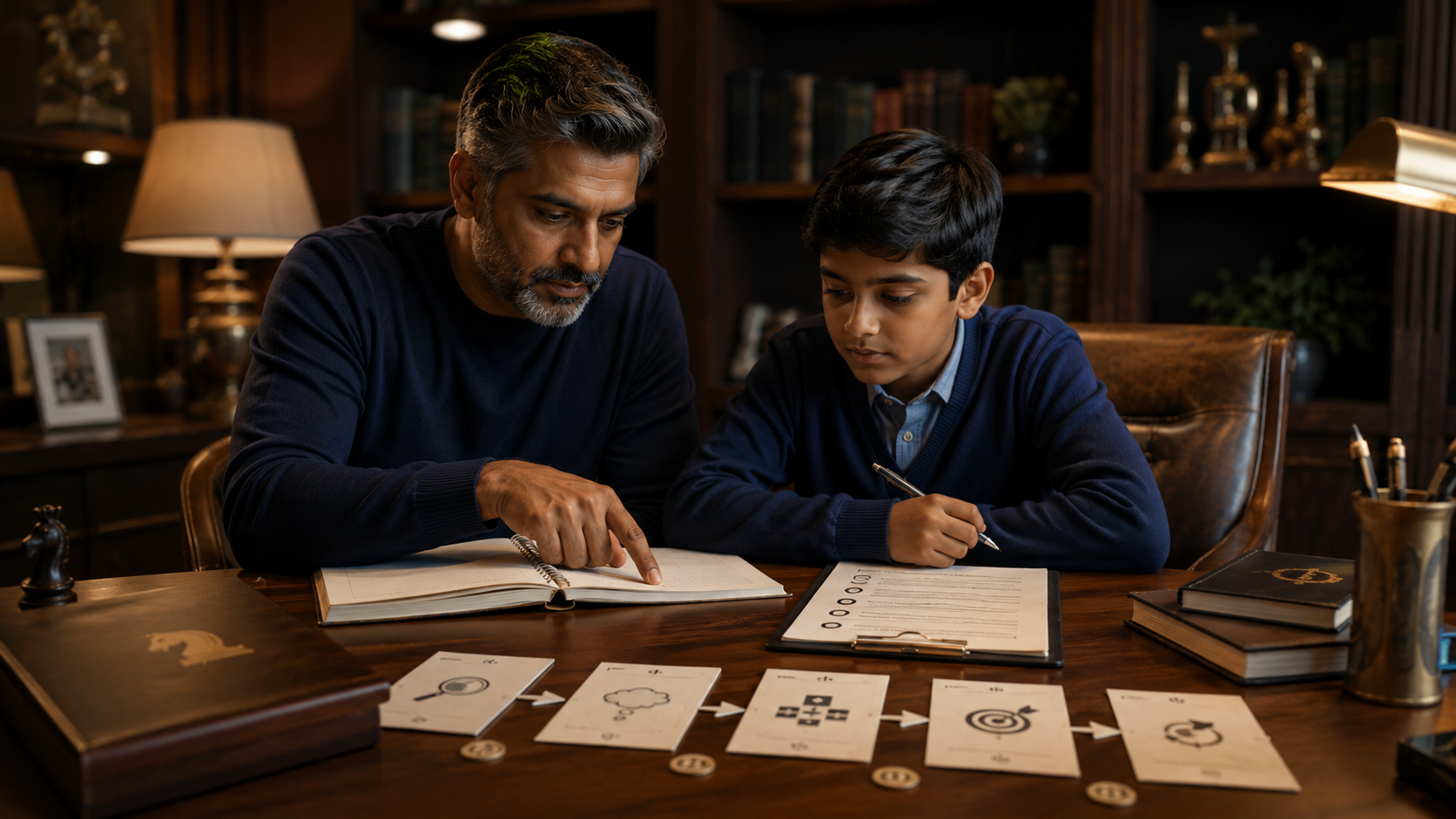
Society of 64 uses The 64 Method as a repeatable training framework: read the position, see the threat, improve what is not working, calculate when it matters, and review the thinking after the game.
The reason for repetition is simple. Under real game conditions, students do not rely only on things they were told once. They rely on thinking steps they have practised enough times that the sequence starts becoming natural.
What tools do online chess coaches use?
The practical setup is usually simple. Most sessions use a video call and a shared digital board on a chess platform such as Chess.com or Lichess. The student needs a laptop, computer, or tablet, a working microphone, and a reliable internet connection.
No special chess software is required. For younger students, the coach may keep the session focused on the shared board and conversation rather than too many tools, so the class remains active instead of passive.
What to expect in the first month
In the first month, the coach is mainly building a picture of the student. By watching several positions and asking the student to explain their thinking, the coach can identify which mistakes are recurring habits and which are occasional lapses.
Most students do not immediately see a major change in game results during this period. The first change is usually in how they approach positions: pausing more, explaining better, and becoming more aware of threats.
The demo class is useful because it gives both the parent and coach a baseline. The parent sees what the process feels like, and the coach gets an initial reading of the student’s current level.
Why this is different from random screen time
The screen is only the medium. The real coaching happens in the thinking conversation. The student is not simply watching content. They are being asked to decide, explain, test, correct, and review.
That is what makes structured online chess coaching useful. It turns chess from information into a training process.
Trial Class
Want to see structured online chess coaching in action?
Book a demo class with Society of 64. Your child plays, the coach observes, and you get a clear view of how The 64 Method works in a live session.
Book a Trial Class →